
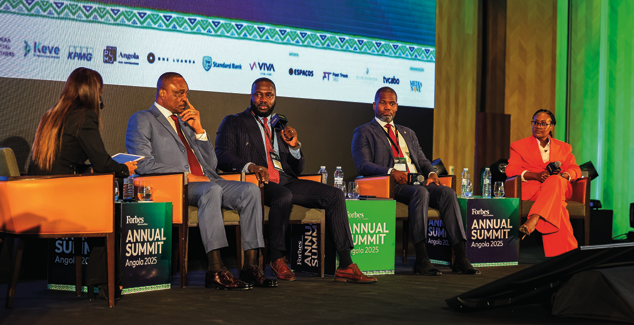
Public and private sector managers gathered at the Forbes África Lusófona Annual Summit 2025 to reflect on what defines Angolan leadership amid economic and social transformation. Communication, integrity and the ability to inspire were central themes of the debate.
The panel “Angolan Leadership Style: What Defines It”, part of the Forbes África Lusófona Annual Summit 2025 held in Luanda, fostered an in-depth discussion on the different leadership approaches adopted by Angolan managers, as well as the challenges of motivating, managing and guiding teams in a changing economic and social context. More than a set of techniques, leadership style was examined as the way a leader directs, inspires and relates to their team, reflecting methods, behaviors, values and a distinct philosophy of authority and decision-making.
The Chairman of the Board of Directors of the Instituto Nacional de Segurança Social (INSS), Anselmo Monteiro—one of the five speakers on the panel moderated by Nilza Rodrigues, Editorial Director of Forbes África Lusófona—argued that leading a public institution requires a multifaceted combination of strategic vision, political responsibility and a firm commitment to the pillars of public administration. According to him, INSS has, in recent years, incorporated private-sector management concepts into public administration as a way to enhance efficiency and results. “We cannot have an empirical public management model. It must be based on planning and oriented toward results, because the citizen on the other side expects concrete responses from public administration,” he stated, emphasizing that the role of the State is to serve citizens by creating solutions, not barriers. He also highlighted the importance of engaging teams and transforming mindsets, acknowledging that this is a gradual process: “This does not happen overnight.”
The President of the American Chamber of Commerce in Angola (AmCham-Angola), Pedro Godinho, pointed to weaknesses in leadership systems as one of the main obstacles to corporate performance in the country. For him, a leader’s fundamental role is the ability to clearly communicate vision, projects and strategy, ensuring they are understood across all levels of the organization. “Top-down communication is essential. When it fails, dispersion arises, because teams lose sight of the central objective and the destination,” he warned, noting that this gap undermines effective corporate leadership.
In the same vein, the CEO of SGS Angola, Adilson Paulo, acknowledged that there is still a long road ahead in leadership—especially in the public sector—but emphasized the emergence of new leaders and voices that are positively representing Angola. He argued that leadership principles should be cultivated early in society, with a stronger focus on compliance and integrity. “The golden rule—treat others as we would like to be treated—should be a foundational principle from childhood. When these values are instilled early, individuals enter the corporate world better prepared to lead,” he said.
For the Managing Director of Alfort Petroleum, Gianni Gaspar Martins, leadership is прежде de tudo about inspiring—particularly in a challenging context like Angola’s, where around 65% of the population is young. In the private sector, he noted, one of the main obstacles to effective leadership is the persistence of informality in many companies. Drawing on extensive experience in the oil sector, he argued that strict attention to processes and procedures—common in capital-intensive industries—should extend across other areas of the economy. He added that a major challenge for today’s leaders is delivering results in a competitive environment that demands thinking outside the box, even when space for innovation appears limited.
The topic of female leadership was addressed by the Founder and CEO of Imcuba Angola, Sofia Chaves, who described women’s leadership in the country as a constant balance between strength and resilience. While acknowledging market progress, she noted that cultural barriers, stereotypes and recognition challenges persist. “It is a path under construction. As leaders, we must open doors and lead by example—showing not only what we say, but above all what we do,” she stated, advocating meritocracy and recognition of competencies as pillars for a fairer and more inclusive leadership.
In summary, participants converged on the idea that effective leaders master a diverse repertoire of styles, adapting them to circumstances, teams and strategic objectives. In a country with abundant resources and strong human potential, managers emphasized that the real challenge lies in aligning energies, strengthening leadership quality and focusing efforts on concrete goals capable of meeting citizens’ needs and sustaining Angola’s economic and social development.
Font: FORBES ESPECIAL ANNUAL SUMMIT ANGOLA 2025 – pg 26, 27.