I have often reflected on the way we talk about education. In many contexts, it is still treated as something limited to school, curriculum, and academic performance. But when we look more deeply at Angola’s future, it becomes clear that education is a much broader issue. It plays a role in the development of human capital, the formation of values, personal discipline, civic awareness, and responsibility toward the collective good.
A country does not grow sustainably through infrastructure, investment, or economic expansion alone. It grows when it is able to shape people who are prepared to think, work, lead, live together, and make decisions with maturity. That is the point at which education stops being merely a stage of life and becomes a strategic asset for national development.
When I speak of human capital, I am not thinking only of technical qualifications. I am also thinking of posture, communication, analytical ability, work ethic, sense of commitment, and respect for others. The market needs competence. Society needs character. And Angola’s future depends more and more on our ability to form both dimensions with the same level of seriousness.
In this sense, education is also preparation for citizenship. It means helping children and young people understand that freedom requires responsibility, that ambition needs method, and that talent becomes stronger when it is grounded in consistent values. A well-formed generation contributes more than productivity alone. It contributes stability, long-term vision, and a better quality of social coexistence.
That is why I find it so important to look at initiatives that understand education in a more complete way. The Gianni Gaspar Martins Foundation presents itself as a non-profit organization based in Angola, focused on human development and on supporting the growth of children, adolescents, and young adults, from ages 0 to 25, in the areas of health, education, arts, and culture.
Within this vision, the Scholarship Program plays a very clear role. Its purpose is to facilitate access to formal education for people with fewer financial resources, provided they meet the Foundation’s requirements. This kind of action carries value that goes beyond immediate support. When access to education is expanded, so too is the possibility of mobility, autonomy, and qualified participation in building the country.
Mwana Luzito reinforces another essential dimension of this conversation. The project, whose name means “respectful child” in Kikongo, was created to promote ethical values, civic principles, and citizenship practices among children and adolescents. By its very design, the initiative recognizes that educating also involves ethical and civic formation. In its fourth edition, announced this month, the project enters a new phase in Luanda, with plans to benefit around 90 children and adolescents between the ages of 10 and 14, in synergy with Kandengues Cientistas to integrate civic education, science, and technology.
There is also one especially relevant aspect in the project My Future Depends on My Present. At the launch of the initiative, the Foundation emphasized the importance of helping students understand how the decisions and actions of the present can positively shape the future. It is a simple idea, but a structural one. Every serious educational effort must develop this awareness. The future does not begin when youth reach adulthood. The future begins in the way one learns to think, choose, and act from an early age.
When we look at these initiatives together, we see a vision of education that seems especially necessary for Angola. An education that opens doors, builds awareness, strengthens discipline, encourages responsibility, and broadens horizons. An education that does not separate knowledge from character, nor talent from commitment.
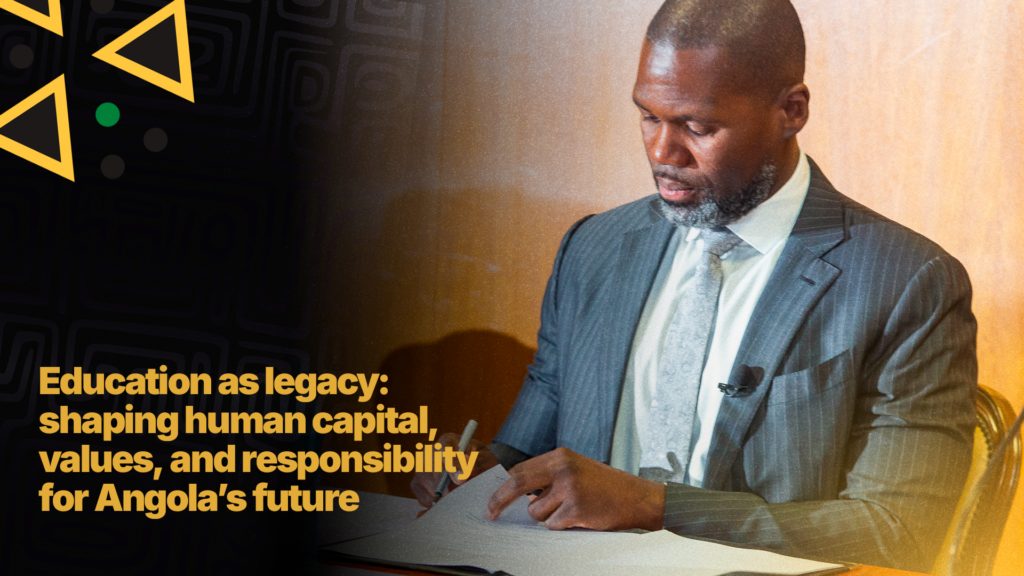
That is the vision that turns education into legacy. Because legacy is not only what is built for the present to see. Legacy is also what is formed within people so that they can sustain the country we hope to build. A nation’s human capital is not born ready. It is cultivated through continuity, high standards, values, and opportunity.
That is why I continue to believe that investing in education is one of the most serious decisions a society can make. Not only because it shapes students, but because it shapes citizens, professionals, leaders, families, and role models for the next generation. And in the end, that is what will give consistency to Angola’s future.
In your view, what is the greatest legacy education can leave to a country: competence, values, or a sense of responsibility?